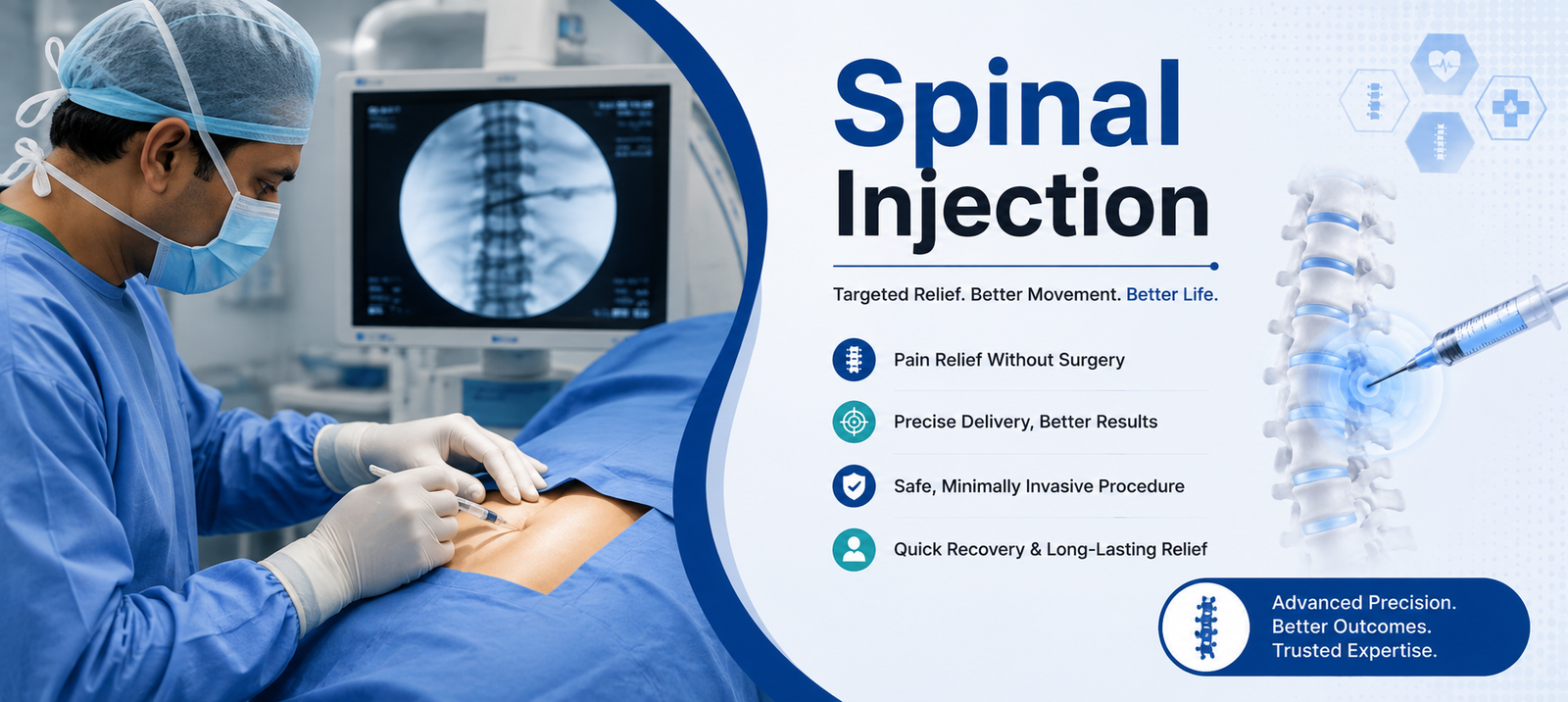
Spinal injection specialist in Delhi
Spinal injections are considered an integral part of non surgical care and management. They use a combination of local anaesthetic and often steroid to a precise target near the spine, such as a nerve root, the epidural space or a facet joint, in order to treat chronic pain, reduce inflammation and diagnose the source of pain without the need to invade surrounding tissues surgically.
Spinal problems are becoming increasingly common
Spinal problems are becoming increasingly common and can affect all ages, causing difficulty walking, limited mobility, and sensation. It's the number one reason why people miss work and struggle with daily activities. Conditions such as slipped discs, nerve compression, spinal stenosis, and chronic back pain can cause sharp pain, numbness, or weakness in the neck, back, arms, or legs.
For patients seeking non-surgical options, spinal injections in Delhi offer a minimally invasive approach to managing chronic back, or radiating nerve pain and act as the key to preventing serious spinal damage. This page explains the main types — nerve root blocks, epidural injections and facet joint blocks — how they are performed to relieve nerve pain, and the risks and benefits they carry, to support an informed discussion with a spine specialist.
What are spinal injections?
Spinal injections are targeted procedures that work by delivering the medication in localized areas of the spine to identify where pain is coming from. For example back, neck, leg, or arm. These injections provide the opportunity for effective pain relief without needing to undergo surgery. The medication is usually a local anaesthetic, which numbs the area. It is often combined with a steroid, to reduce inflammation of the spinal nerve roots in your low back, ease chronic pain, and support improved mobility.
These injections can have both diagnostic and therapeutic purposes. As a diagnostic procedure, an injection can help locate the exact anatomical structure responsible for pain. If the pain eases after numbing, this points to the true source of your pain. Therapeutically, these injections may provide temporary relief by delivering anti-inflammatory medication directly to the source of pain, creating an opportunity to improve movement and support rehabilitation. Often, one injection can serve both purposes.
The three common types target different structures:
Nerve root block — the medication is placed around a specific nerve as it exits the spinal column.
Epidural injection — medication delivered directly into the epidural space - the area surrounding the spinal cord and protective nerve sac to treat pain that radiates from your spine out into your limbs.
Facet joint block — medication directed at one of the small facet joints connecting the vertebrae, to relieve localized neck or back pain
Who is a candidate? (Indications)
Spinal injections are considered when pain is thought to arise from a specific spinal structure and back or neck pain and inflammation around irritated nerves does not go away easily with conservative treatments like rest, oral anti-inflammatory drugs, and physiotherapy. Patients with sciatica or arm pain, spinal stenosis, and various other conditions arising from spine need a spine specialist in Delhi .
Common situations include:
- Sciatica or arm pain caused by irritation or compression of your sciatic nerve where a nerve root block or epidural may help.
- Lumbar spinal stenosis, where an anti-inflammatory epidural injection may ease nerve root swelling and relieve pain relief from a herniated disk and spinal stenosis.
- Suspected facet joint pain, where a facet block can help confirm if a specific facet joint is the true source of your spinal pain.
- Uncertain pain source, where a carefully chosen injection helps clarify the underlying cause. This is particularly useful because back and neck pain rarely stem from just one isolated part, most common culprits include strained muscles and sprained ligaments.
Injections are usually one part of a broader plan that includes physiotherapy, targeted exercises, and smart activity changes as well as lifestyle modifications. They are generally not the first or only step, and selection depends directly on your specific symptoms, their exact location, and the results of your physical or imaging tests.
How the procedure is performed
Spinal injections are most commonly performed as a short outpatient procedure. They are widely used to manage chronic pain caused by irritation of the spinal nerve roots in your low back. Sometimes, not always, an IV is started to lightly sedate the patient. The broad steps are:
Before beginning the procedure, you may be asked to change into a gown.
You will then be positioned on your stomach or side that will give the doctor easy access to the injection site.
Once you are positioned, the skin will be cleaned and numbed with an antiseptic solution and a local anesthetic to minimize pain.
Sometimes, nerve roots that are attached to the spinal cord can become pinched or inflamed. Using image guidance such as live X-ray, a fine needle or medicine will be guided to the intended target area— where the inflammation lies.
A small amount of contrast dye may be used under live X-ray guidance to confirm correct needle position before injecting the medicine
The medication, usually a mix of a local anesthetic and a corticosteroid is injected directly into the epidural space around your spinal nerves
After the injection, the needle is removed and a small bandage is applied over the site.
The patient is observed for a short period typically 15 to 30 minutes— in a recovery room to evaluate the early response to the injection.
Image guidance and accuracy
Advance image guidance is fundamental to modern spinal pain intervention procedures such as spinal injections. Real-time X-ray, often with contrast, or other imaging techniques enable and help deliver medicine accurately to the affected nerves and confirm the target before any medication is administered.
Accurate targeting is important for both the diagnostic and therapeutic roles of spinal injections. For diagnosis, precise needle placement at the intended structure helps ensure that the patient’s response is more meaningful and interpretable. For treatment, accurate needle placement helps deliver medication directly to the targeted anatomical site near the spinal nerves or joints while supporting safe practice. The choice of target structure is guided by the patient’s symptoms, clinical findings, and imaging.
Benefits and risks
Spinal injections in Delhi generally have a favorable safety profile and are considered safe when appropriately performed; however, as with any other medical procedure, the potential benefits should be carefully weighed against the associated risks.
Potential benefits
- Helps identify the source of pain and guide subsequent treatment decision.
- May provide a period of pain relief, creating an opportunity to engage more effectively in physiotherapy, exercise and gradually return to normal activities.
- Offers a minimally invasive, outpatient treatment option that may reduce the need for or delay surgery in selected patients.
Recognised risks
- A temporary increase in pain or discomfort before the intended benefit is experienced.
- Bleeding (if a blood vessel is accidentally damaged), bruising, or infection at the injection site.
- Headache, particularly following certain epidural procedures.
- A transient rise in blood glucose levels or other short-term effects related to steroid medication.
- Rarely, temporary nerve irritation or other complications such as nerve injury
Before pulling off the procedure, a spinal injection specialist in Delhi will discuss the potential risks and benefits in detail with you, and explain any precautions that may be particularly relevant to your medical condition and overall health.
Alternatives
Injections are one component of a broader range of treatment options for spinal pain, and their role is best considered in the context of an individual’s overall clinical picture.
Physiotherapy and exercise form the cornerstone of non-surgical treatment for many spinal conditions. They can help improve physical function, mobility, and strength.
Medication and lifestyle changes may help manage symptoms such as pain and inflammation while supporting continued movement.
Surgery may be considered when there is significant nerve or spinal cord compression, spinal instability, or persistent symptoms despite appropriate non-surgical treatment.
Injections do not correct underlying structural abnormalities. Rather, they are best viewed as a complementary treatment that may help manage pain and facilitate rehabilitation, while providing diagnostic information.
Recovery and outlook
Firstly it is important to know that recovery isn't the same for everyone. However, recovery from a spinal injection in Delhi is usually swift. Most people return home the same day and resume normal activities within a day or two, following their clinician’s advice. While mild soreness at the injection site may occur initially but usually it settles quickly. The duration of pain relief varies. Some experience benefit for weeks or months, while others may experience shorter-lasting relief or little improvement. When effective, injections can create an opportunity to progress further with physiotherapy and graded activity. As they target symptoms rather than the underlying cause, ongoing self-management remains important.
When to seek a specialist opinion
Evaluation by a spinal injection specialist in Delhi may be appropriate when back, neck, leg arm or spinal pain persists despite conservative treatments like physiotherapy or when the source of pain remains unclear. Progressive weakness, worsening numbness, or loss of bladder or bowel control requires prompt assessment to exclude serious nerve compression. A spinal injection specialist in Delhi can determine whether a spinal injection may be appropriate and how an injection fits within the overall treatment plan. In addition, he will also explain its diagnostic and therapeutic role to you.
Frequently asked questions
What is a spinal injection?
A spinal injection is a common non-surgical treatment designed to deliver medication, usually a local anaesthetic and often a steroid, to a precise target near the spine such as a nerve root, the epidural space around the vertebrae or a facet joint. It makes use of powerful anti-inflammatory medicines to find the source of pain and to provide relief as part of non-surgical care.
What is the difference between a nerve root block, an epidural and a facet injection?
A nerve root block is a minimally invasive injection that targets a single nerve as it leaves the spine. Like other injections, it usually contains a local anesthetic and in some cases a corticosteroid intended to reduce inflammation. An epidural injection administers medication into the epidural space around the nerves. A facet joint block targets a small joint at the back of the spine to diagnose or relieve back and neck pain. Each aims at a distinct anatomical structure depending on the suspected source of pain.
Are spinal injections diagnostic or therapeutic?
Spinal injections are both diagnostic and therapeutic. If pain eases after an injection to a specific structure, it confirms that the targeted area is the source of your pain. This is the diagnostic role. The same injection may also provide a period of relief from back, neck, arm or leg pain caused by inflamed spinal nerves. This is the therapeutic role of a spinal injection.
Why is image guidance used?
Image guidance helps doctors place the needle accurately at the intended target while ensuring safety. Using live X-ray, sometimes with contrast dye, a spinal injection specialist can clearly see the spine, confirm correct positioning and ensure the medication reaches the target site. This improves precision and helps reduce potential risks such as misplacement.
Do spinal injections replace surgery?
No. Spinal injections are a part of non-surgical management and do not replace surgery in every case. They are primarily used to diminish pain and inflammation that often accompanies the condition, help identify its source, and support mobility, but they do not correct structural problems. For some people they may reduce or delay the need for surgery as they provide temporary relief. For others undergoing severe nerve compression, and spinal instability, surgery may still be necessary.
How long does the relief last?
Spinal injections provide rapid relief enabling you to get back to your daily activities but relief can vary widely between individuals depending on the condition, type of injection and individual response. While some people may experience relief for weeks, some people may benefit for several months or up to a year. Injections are often combined with physiotherapy and activity to support longer lasting improvement.
What are the risks?
A temporary increase in pain is one of the most common side effects that some people experience after a spinal injection. Other risks include bleeding and infection but that is rare. It can also cause a specific type of headache known as spinal headache and temporarily increase blood sugar from steroids. Nerve irritation and potential injury are also among the risks involved but generally uncommon. Your specialist will discuss these before the procedure. However, spinal injections are usually well tolerated.
How many injections can I have?
While some spine specialists suggest that people should not receive more than two or four injections per year, there is no single fixed number. It all depends on the response, the type of injection and the medication used. A specialist will advise how many injections you can safely receive for your situation.
Concerned about your spine health?
Get an expert opinion from Prof. (Dr.) Bhavuk Garg — Max Hospital Delhi, Ex-AIIMS.
Book a Consultation WhatsApp UsOr send your query